Thinking with The Long Now
by Abigail Browka
I often think in digital outcomes. Something complex with reach is achievable online, and I've spent the past few years building toward that — Digital tools that meet people where they are.
But The Long Now Foundation does something different. They take complex, expansive realities like civilizational time, climate, governance, the practice of long-term thinking and seek to embody them here and now. They have brought into being durable artifacts like a clock built to keep time for 10,000 years, inside a mountain in West Texas. A forest in Norway holding manuscripts that will not be read for a century, including one from Margaret Atwood, a favorite author. A five-digit year, 02026 instead of 2026, adding one quiet mark to remind us that we are living inside a longer story.
Quiet objects. Considered language. Things made to last past the people who made them.
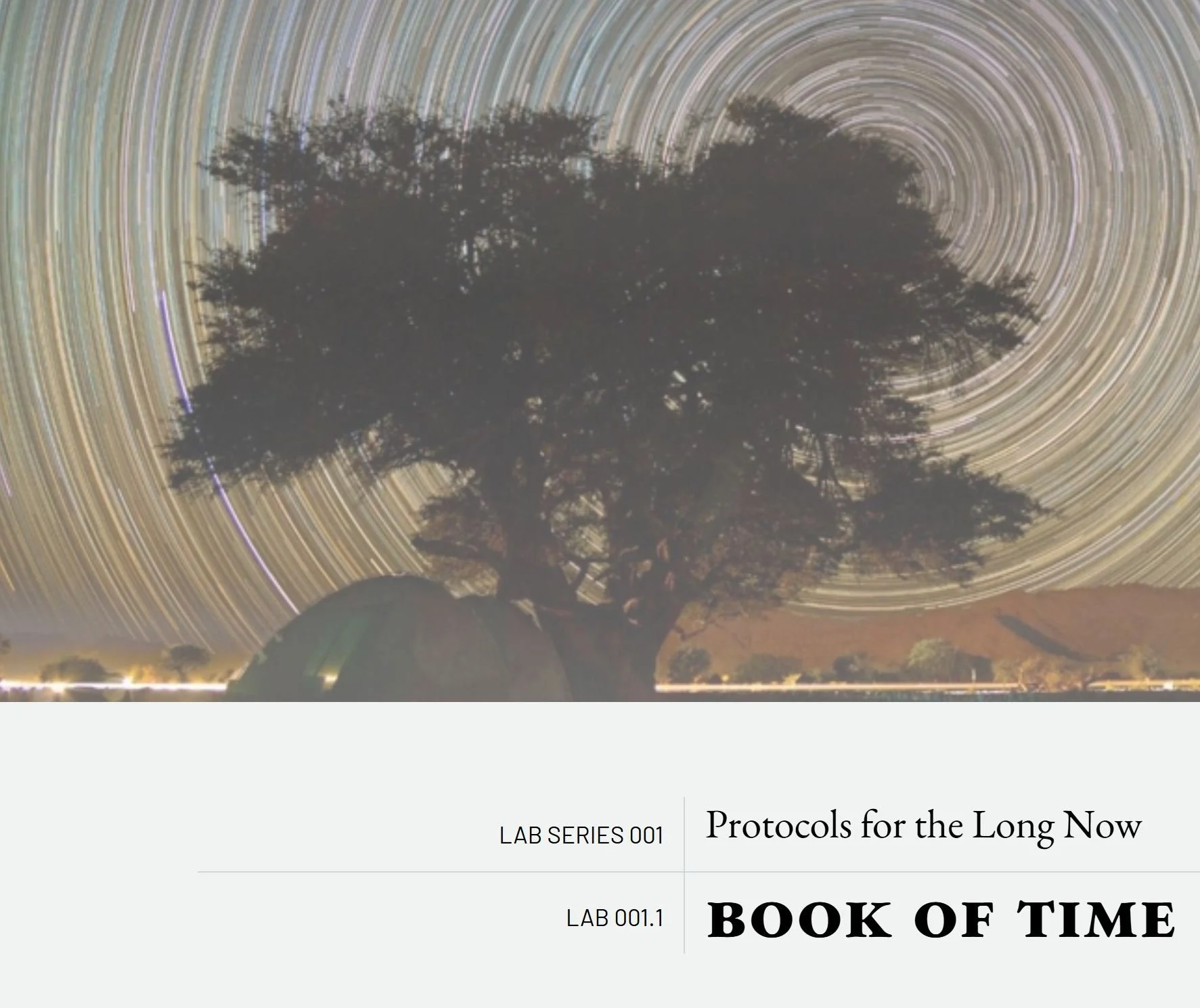
When I saw their recent Call for Proposals — Book of Time, asking for new ways of marking, experiencing, or making sense of time — I felt the question pull at me. Their core contention is that our models of time shape human behavior. Changing the model can change the way humans experience time.
Personally, I love the thinking stage of building. The fine-tuning of a conceptual idea into something actionable. For Book of Time, I began in an unlined spiral notebook.
Handwriting. Phrases. Pathways. Questions. Words that did not belong together yet. Concepts that seemed to have no application, but might later. I write those down too.
When I look back at the early pages of this project, I can still see the idea before I knew what it was. I can see where it was vague. I can see where it deepened. I can see the sentence that became the center, though I did not know it at the time.
When I am working out something new I often draw from three sources: experience, reason, and canon.
A part of my canon says there is One who inhabits eternity (Isaiah 57:15) who able to view the past, present and future as an eternal now.
Rather in most culture today, aging is experienced as subtraction.
A birthday becomes a countdown.
Adult life becomes a slow narrowing of possibility.
But many spiritual traditions, including my own, hold a different imagination. A human life is not a diminishing resource. A life is something entrusted. Something tended. Something that can deepen.
That is the principle underneath what I submitted for Book of Time. I won't share here what I submitted. That will be a later build.
What I can say is the principle underneath it: spirituality treats human development as stewardship, not decline. It holds a life as something that deepens over time, not something that subtracts. That is a quieter claim than most of what the present moment rewards. It is also, I think, true.
This October, I am grateful to be returning to San Francisco. I hope to see redwoods. To walk near the ocean. To be in a place where ancient trees and cold water make the human timeline feel smaller in the best possible way.
Abigail Browka writes and builds at the intersection of digital tools and ancient practice.