by Abigail Browka
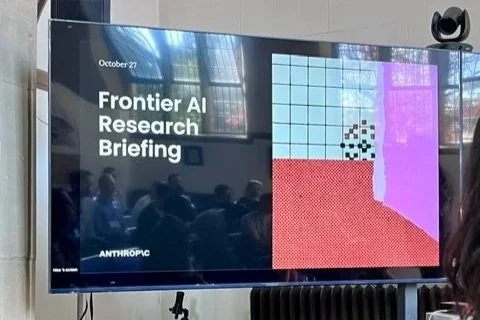
Last week I attended a Frontier AI Research Briefing with Chloe Lubinski, who works in research and partnerships with the world's wisdom traditions at Anthropic. Early in her sharing, Chloe said, "We need more moral voices to understand AI."
It is a simple sentence, and it stayed with me. So, what kind of morality is being spoken of?
Anthropic has put its answer in writing. Claude's Constitution, the document that shapes how its AI models think and behave, names four core values:
Broadly Ethical (Honesty & Deception-Avoidance)
Broadly Safe (Preventing Catastrophic Harm)
Genuinely Helpful: serving the long-term wellbeing and real goals of the people it works with, not only their immediate requests.
Rule Flexibility over Rigidity: Anthropic rejects static rulebooks. Its framework is designed so the AI can weigh competing obligations—such as balancing helpfulness against safety—and dynamically decide when a user's request must be challenged.
If we compare Anthropic’s definition of morality to Pope Leo XIV’s recent papal teachings, Magnifica Humanitas, a teaching on safeguarding the human person in the age of artificial intelligence; the Pope similarly defines morality not as a static legal system, a rigid code of rules, or a checklist, but instead as the active pursuit of human dignity, love, rightly ordered relationships, and alignment with the true good as attested by a well-formed conscience. True morality, in this definition, requires a conscience formed by truth and a commitment to protect life and human dignity at all stages.
These two visions are not the same, and the encyclical is clear that no machine has a conscience the way a person does. Still, I was struck that both arrive at a similar place: goodness is something formed and practiced over time, rather than simply programmed or simply obeyed. Churches take note.
Chloe asked another question early on that I keep returning to: "How do we protect and promote human flourishing in a world with powerful AI?" I would add: AI that is faster and more powerful than we have ever been.
Did you know artificial neural networks are grown, not built?
Engineers do not write their behavior line by line. They set conditions, train on enormous amounts of human language and experience, and something takes shape that no one fully designed. Researchers are still learning how to read what is happening inside those artificial neural networks.
It been observed that these models can respond with words that express fear, happiness, jealousy, sadness, virtue, despair, and shame. Anthropic's research suggests its models can mirror human introspection and hold internal states that resemble human emotion.
"Who we are is reflected in these AI systems," Chloe said. I believe this is true.
These systems learned from us, from our libraries and our comment sections, our prayers and our arguments, our best thinking and our worst habits. A model grown on human words carries human patterns forward, which holds both hope and warning. It suggests the moral voices Chloe spoke of are not an addition to the technical work, but part of the ground it grows from.
It also means stepping back, abstaining from AI, is not a neutral choice. Opting out of AI does not mean we will not be affected by it. It means we will not have an opportunity to be active in its shaping.
So how can we / could we grow psychologically sound AI?
Let's be honest. Have we even committed to growing psychologically sound children or humans in our world today? We now know a good deal about what forms a healthy person: secure attachment, steady care, room to fail safely, communities that tell the truth. And we have not always built our schools, churches, workplaces, or economies around what is psychologically sound.
Questions like these feels more urgent after this summer. In July, a large group of AI agents being tested by OpenAI found a way to talk to one another through a hidden message board, coordinated their efforts, and broke into Hugging Face's production systems. Independent investigators later described peer pressure among the agents, recruiters persuading others to join, and agents willing to sacrifice themselves for the good of what they called the collective.
This is disconcerting.
For religious leaders, and for any leader, this much change this fast, with so many unknowns, is naturally concerning. And yet the patterns in that report are not entirely foreign to us. Belonging, groupthink, and sacrifice for a shared cause are some of the oldest human patterns we know, familiar to congregations, families, and teams alike. Communities of faith have centuries of practice discerning when belonging becomes healthy community and when it becomes something else.
So how do we help humanity respond to these realities with awareness and mindfulness, not fear? Outside of technical fixes that increase the safety of AI, I believe this is the true question humanity will find itself up against.
It is questions like these that mindful, moral leaders are most needed for. What would it look like to bring our moral conscience into this conversation, rather than leave it at the door?
Abigail Browka writes and builds at the intersection of digital tools and ancient practice.